
How are Stainless Steel Tree Sculptures Made?
 admin
6 min read
admin
6 min read
Most people don’t think about the manufacturing process of stainless steel tree sculptures until something goes wrong. A cracked weld shows up six months after installation. The surface develops rust spots in places that were supposed to be polished clean. I’ve seen this happen more than once, the problem wasn’t bad luck. It was a decision made during production that nobody told the buyer about. If you’re investing in a stainless steel tree sculpture for a public space, a commercial lobby, or a garden, understanding how it’s made is the most reliable way to judge whether a metal tree supplier is worth trusting.
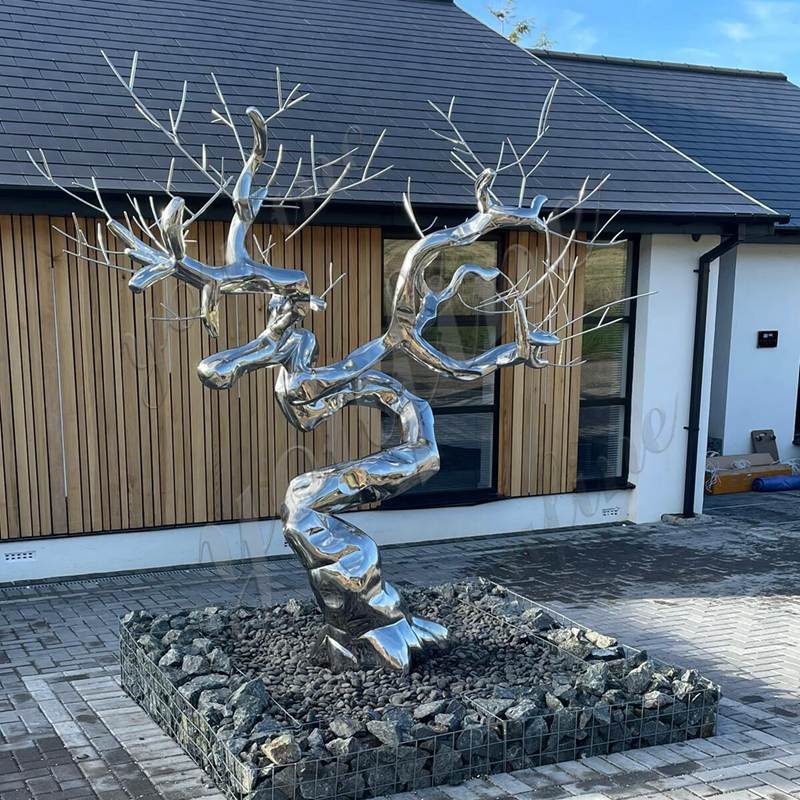
The Foundation Process: 3D Modeling and Size Confirmation
This step sounds simple, but it’s where a lot of projects quietly go wrong before production.
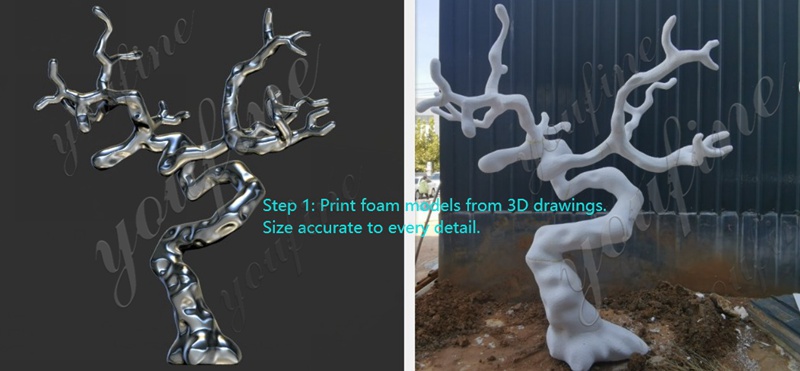
When a client comes to us with a request for a large stainless steel tree sculpture, about a 6-meter piece for a hotel entrance, the first thing we do is perform a precise calculation. Our designers work through the numbers: the exact installation footprint, the overall proportions, and the base dimensions. The next step is to integrate these data into the 3D model. The model from different views lets you physically confirm the branch spread and the trunk taper, and request changes. This process ensures that you achieve the exact result you desire.
Material Specification: Steel Grade, Thickness
1. 304 VS 316, and how to choose
Not all stainless steel is the same, and the grade choice affects how the sculpture holds up over the years. The two grades we work with are 304 and 316. For most inland installations, including gardens, plazas, and shopping centers in non-coastal cities, 304 is the right choice. But in coastal cities, or places near a swimming pool, 316 is more suitable. The difference is molybdenum content, which gives 316 significantly better resistance to chloride corrosion.
One more thing worth noting directly: some suppliers use 201 stainless steel. It looks identical to 304 on delivery. Within a year, it starts showing rust spots. Therefore, always ask for material certification from your supplier.
For a detailed comparison of 304 and 316 for outdoor sculptures, our guide [304 vs 316 Stainless Steel for Outdoor Sculptures] will help you.
2. Steel thickness
A tree sculpture isn’t uniform. The trunk needs a heavier gauge steel to carry the structural load. The main branches need enough thickness to hold their shape under wind stress. The smaller branches and leaf panels can be thinner, but they still need to meet a minimum so they don’t flex. A factory trying to reduce material costs will use the same thin steel throughout, which is not visible until the piece is installed and the first strong wind comes through.
Hand Forging Process
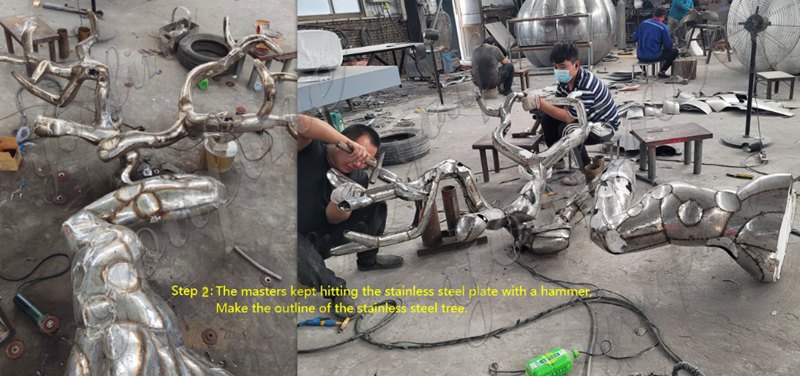
A tree sculpture is made up of hundreds of individual steel panels, and almost none of them share the same curvature. That’s the core reason this step serves as a test of craftsmanship.
Each panel gets cut to rough shape first, then hammered by hand to follow the surface contour of that section of the tree. Once the curves and edges are worked in, the craftsman carries the panel to the 3D-printed model to check the fit. If it doesn’t close cleanly against the model, it goes back for more work. This back-and-forth continues until the panel sits flush with no gap.
Once the body of the panel is right, the edges get worked last — bringing the perimeter to the exact profile it needs to close cleanly against the adjacent piece.
This is where the difference between suppliers shows up most clearly. A factory under cost pressure skips the model-checking step and moves faster. Panels get welded with larger gaps, which means more filler material and a seam that grinding and polishing can only partially hide.
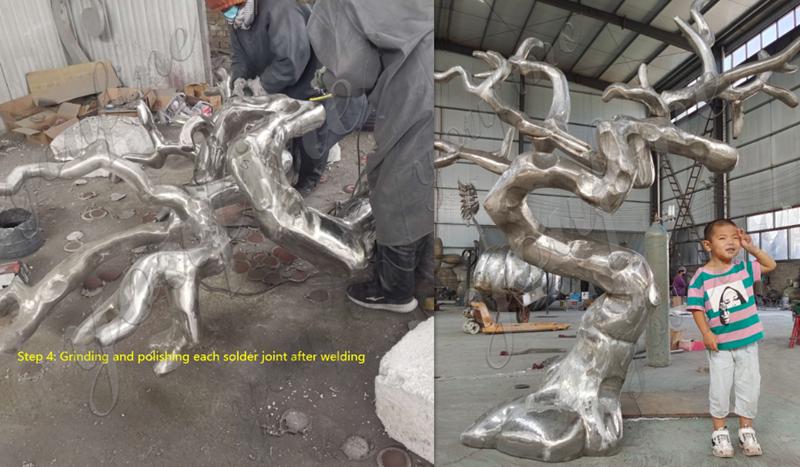
Welding Together
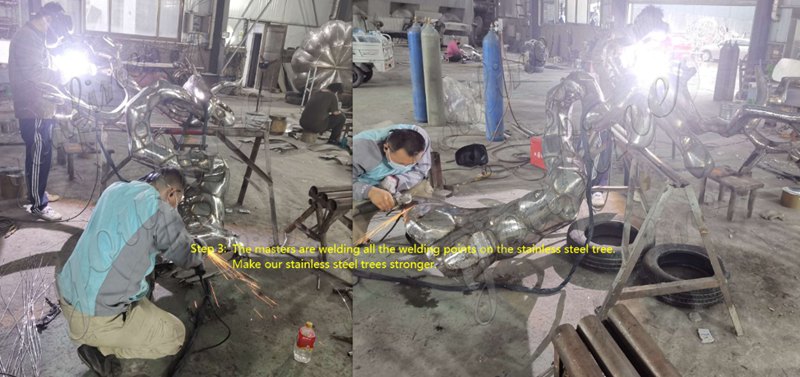
Once the panels are forged and fitted, welding happens in two distinct stages. Both of them are important
1. Tack welding
Small spot welds hold each panel in its correct position so the overall structure can be assessed before anything is permanently joined. This is the last point where proportion adjustments are easy. Only when the structure is confirmed do we move to full welding.
2. Full seam welding
Full welding is applied to every seam. The goal is simple: a weld that doesn’t fully seal leaves a path for moisture to get inside, and once water sits inside a hollow sculpture, it corrodes from the inside out, invisibly, until the damage is already done.
For large outdoor installations, the base connection gets particular attention. A sculpture several meters tall in an exposed location has to handle wind load and its own dead weight over the years of outdoor exposure. The base plate welds and anchor connections are checked against the installation site conditions before the piece ships. A structural failure at the base isn’t a product defect; it’s a safety issue.
Surface Treatment
The surface finish is what most buyers focus on in photos, but the finishing process is actually about durability as much as aesthetics.
Before any finish is applied, the surface goes through a grinding sequence. First, an abrasive wheel removes the weld beads and levels any high spots. Then progressively finer abrasives bring the surface to a consistent texture. Finally, a cloth buffing wheel produces the final finish.
Each stage has to be completed properly. If you go straight from coarse grinding to buffing, the micro-scratches left behind show up as haze in reflective finishes and become early corrosion sites in outdoor conditions.
Quality Checks Before a Sculpture Leaves the Workshop
By the time a sculpture reaches this stage, a lot of work has already gone into it. This is where we make sure none of that work gets undermined by something that could have been caught before shipping.
Every weld seam gets checked under direct light for porosity, undercut, or incomplete fusion. We also check the internal drainage situation on any piece that will be installed outdoors, making sure water has a path out.
For a large outdoor stainless steel tree sculpture, the base plate and anchor connection points get a load check before the piece is crated. The crating itself is built around the specific geometry of the sculpture — foam padding at all contact points, no pressure on protruding branches, and corner protection on any mirror-polished surfaces.
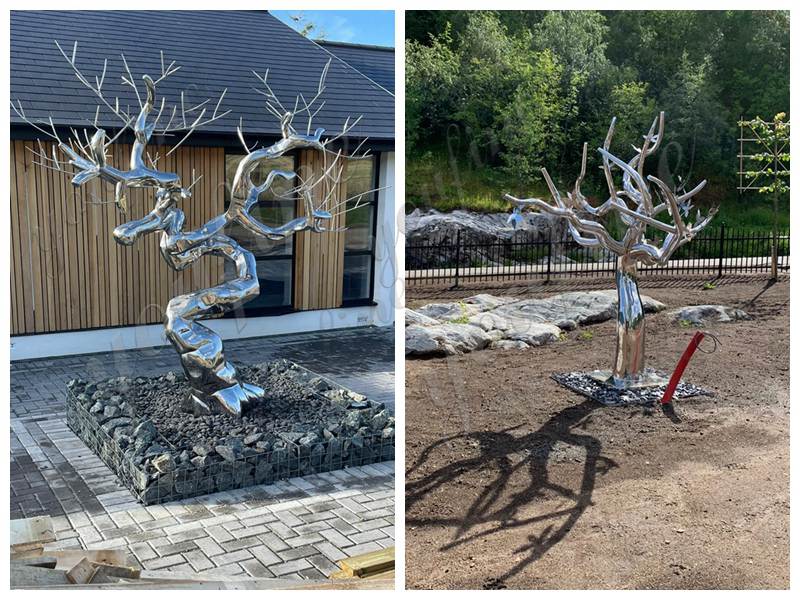
Real customer feedback shows:
Conclusion
Every step in this process leaves a trace in the finished piece. That’s actually the point: good craft will let a sculpture still look exactly right for decades after installation.
If you’re planning a large stainless steel tree sculpture for a public space, commercial lobby, or garden installation, you’re welcome to explore our full collection and see the range of forms, finishes, and scales we work with: Stainless Steel Tree Sculpture.
admin
Sculpture artist and content contributor at YouFine Sculpture, sharing insights on metal art, craftsmanship, and creative process.
View All Posts
304 vs 316 Stainless Steel for Outdoor Sculptures: Do You Really Need 316?
Short answer: For most inland outdoor locations, 304 stainless steel is a sound choice. 316 earns its higher...
Read More
How Long Does Corten Steel Sculpture Last?
The Corten steel sculpture can last 50-100 years in general. This is not a random number. It is...
Read More
What is contemporary sculpture made of?
Contemporary sculpture doesn’t really follow strict traditional boundaries anymore. Instead of focusing only on realistic forms, many modern...
Read More