
304 vs 316 Stainless Steel for Outdoor Sculptures: Do You Really Need 316?
 Tina
7 min read
Tina
7 min read
Short answer: For most inland outdoor locations, 304 stainless steel is a sound choice. 316 earns its higher price where the air carries salt or chlorides: coastal sites, areas where roads are salted in winter, and spaces near swimming pools. The grade is only half the story, though. How the sculpture is welded, polished and cleaned decides whether it stays bright.
Customers ask me this before almost every outdoor stainless steel project. Both grades look the same when they leave the workshop, so it is fair to wonder whether 316 is a real upgrade or just a bigger invoice. The answer depends on where the sculpture will stand.
Why the Grade Matters Outdoors
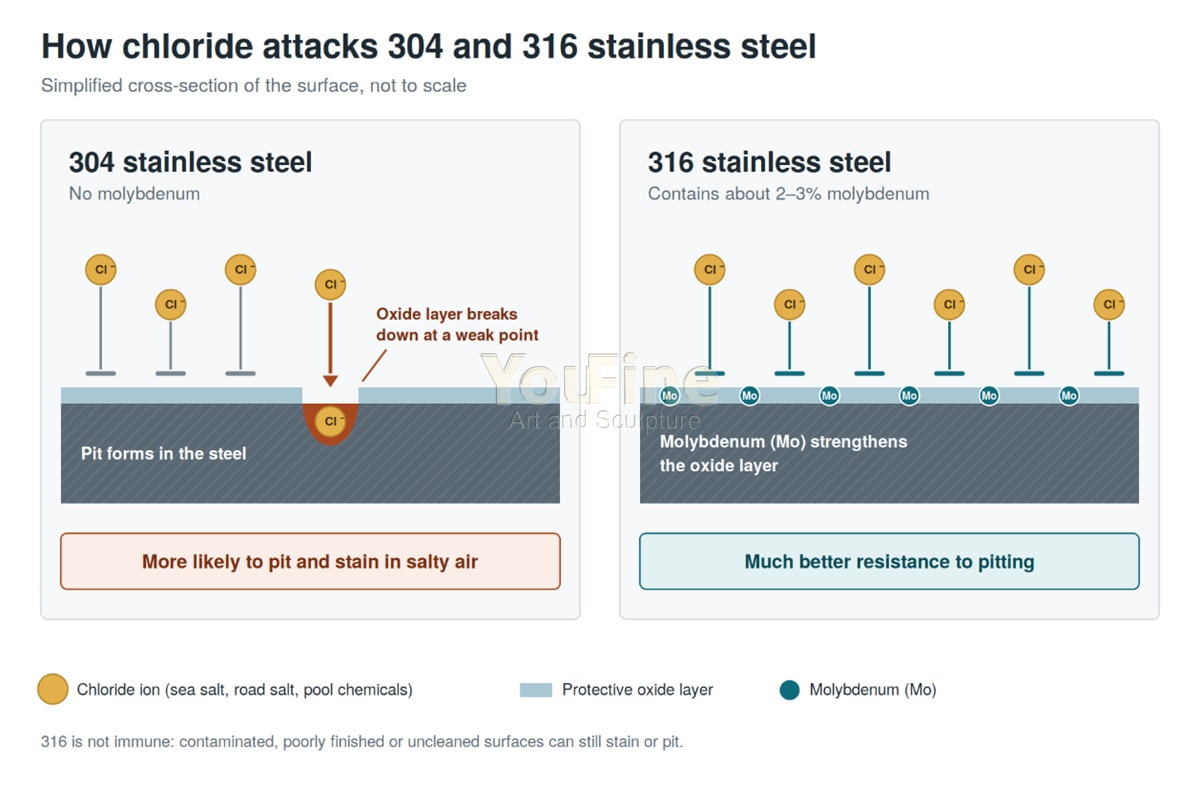
Stainless steel resists corrosion because chromium forms a thin, self-repairing oxide layer on the surface. That layer copes well with rain, sun and city air. Chloride ions (from sea spray, road salt or pool chemicals) are different: they can break down the layer in small spots, which leads to pitting.
This is where the two grades part ways. 316 contains about 2–3% molybdenum, and 304 contains none. Molybdenum makes the protective layer much more resistant to chloride attack.
Engineers often compare grades with the PREN (Pitting Resistance Equivalent Number), calculated as %Cr + 3.3 × %Mo + 16 × %N. Because of its molybdenum, 316 scores several points higher than 304 on typical compositions. The formula gives a relative ranking, not a guarantee for a specific site.
Composition at a Glance
| 304 | 316 | |
|---|---|---|
| Common designations | UNS S30400 / EN 1.4301 | UNS S31600 / EN 1.4401 |
| Chromium (Cr) | 18.0–20.0% | 16.0–18.0% |
| Nickel (Ni) | 8.0–10.5% | 10.0–14.0% |
| Molybdenum (Mo) | not specified | 2.0–3.0% |
| Carbon (C) | ≤ 0.08% | ≤ 0.08% |
Nickel stabilizes the austenitic structure and improves toughness, and it is also a major driver of material cost. Molybdenum is the element that matters most for outdoor sculptures.
Mechanical strength is very similar between the two grades. The practical difference is corrosion resistance, not load capacity.
Which Grade for Which Environment?
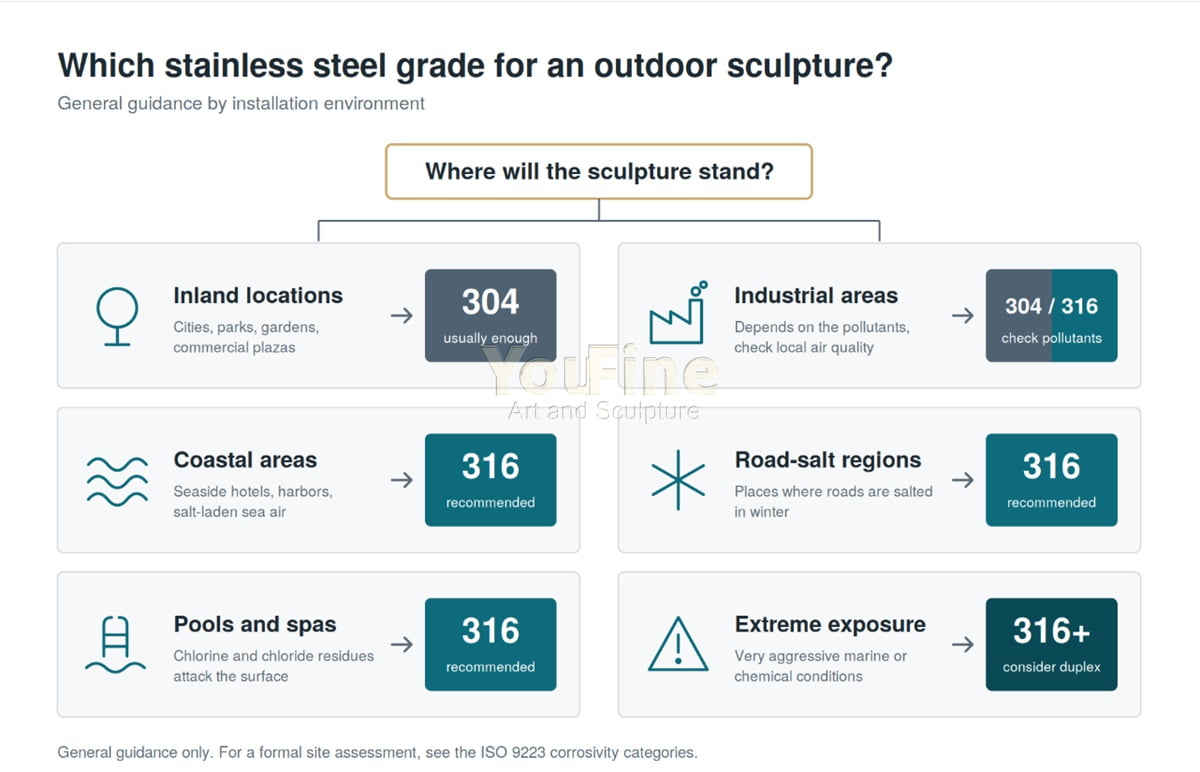
There is no single “distance from the sea” rule, because wind direction, exposure and how often rain washes the surface all change the picture. Here is a practical starting point:
| Environment | Recommended grade | Why |
|---|---|---|
| Inland city, park, garden, commercial plaza | 304 | Low chloride exposure; regular rain and light cleaning are enough |
| Industrial or heavily polluted air | 304 or 316, depending on the pollutants | Check the local air quality before deciding |
| Coastal area, seaside hotel, harbor front | 316 | Salt in the air is the main threat to the surface |
| Regions where roads are salted in winter | 316 | Salt spray from traffic can reach nearby sculptures |
| Near swimming pools or spa areas | 316 | Chlorine and chloride residues attack the surface |
| Very aggressive marine or chemical exposure | 316 as a minimum; consider duplex grades | Some conditions go beyond what 316 handles comfortably |
For a more formal assessment, the ISO 9223 atmospheric corrosivity categories are the standard reference for classifying a site.
Does the Grade Change the Mirror Finish?
Both grades can be polished to the same mirror finish, so the difference does not show on day one. It shows years later.
In salty or humid air, a 304 surface is more likely to develop pitting, dull patches or brownish tea staining. Tea staining is a cosmetic discoloration rather than structural damage, but on a mirror sculpture it is very visible. 316 is less prone to it.
Two honest caveats:
- 316 is not maintenance-free. Near the sea, salt deposits still build up in areas that rain does not reach, such as undersides and sheltered corners. Periodic rinsing with clean water keeps them from concentrating.
- A smoother surface helps. A well-polished surface holds less salt and dirt than a rougher one, whichever grade you choose.
Fabrication Matters as Much as Grade
A sculpture in the right grade can still rust if it is made carelessly. Three things are worth asking your supplier about:
- Weld treatment. Welding leaves heat tint and can locally reduce corrosion resistance. Welds should be cleaned, pickled or polished back and passivated. Low-carbon versions (304L, 316L) are commonly used for heavily welded work.
- Iron contamination. Grinding or cutting with tools that have touched carbon steel can embed iron particles that later show up as rust spots. Dedicated tools and post-fabrication passivation prevent this.
- Material certificates. Ask for a mill test certificate confirming the grade actually supplied. It is the only reliable way to know that a sculpture sold as 316 really is 316.
Real Projects: Mirror-Polished Stainless Steel by the Sea in Mexico and Vietnam
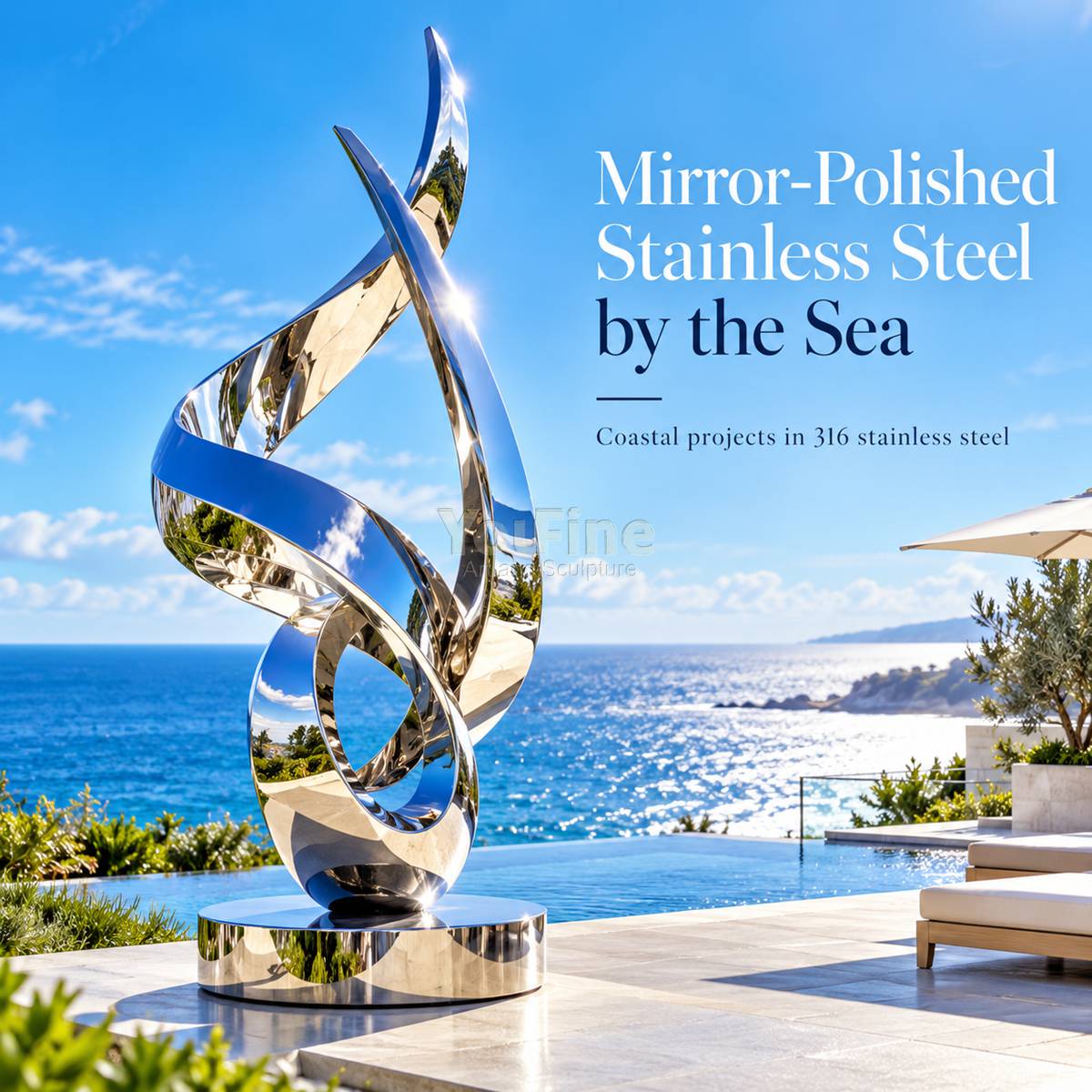
We fabricated mirror-polished sculptures in 316 stainless steel for two seaside sites, one on the coast of Mexico and one on the coast of Vietnam. Both stand close to the ocean, where salt in the air is the main threat to a mirror finish, because a surface this polished shows every dull patch or stain immediately.
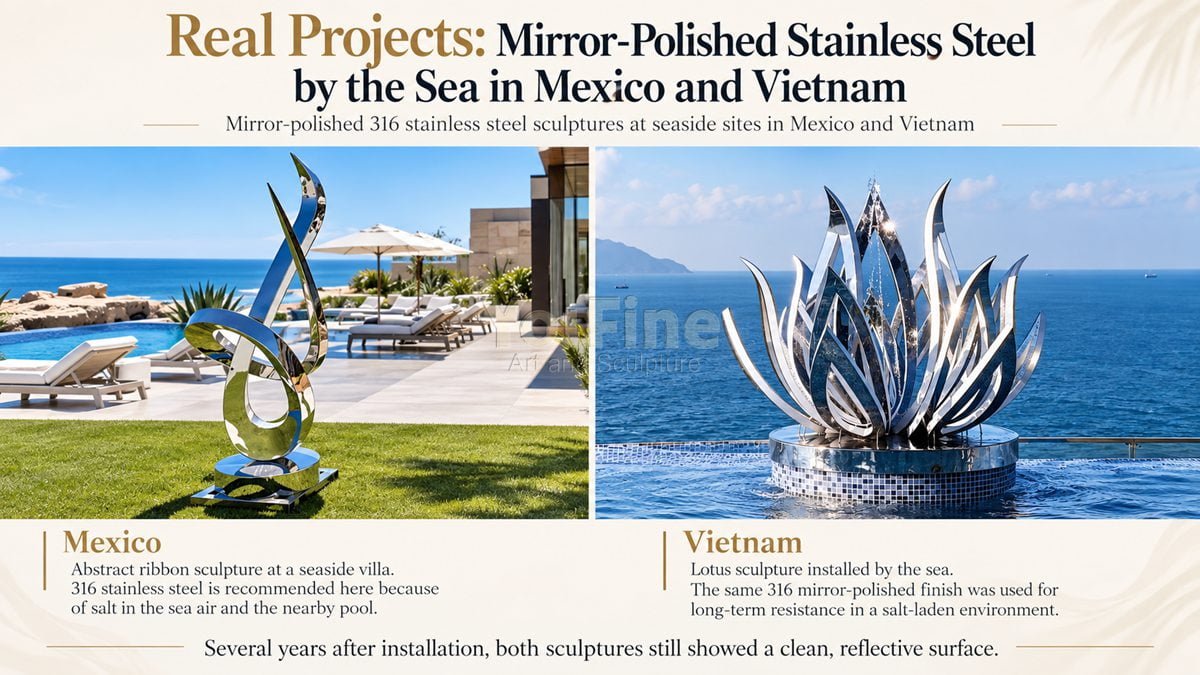
Mirror-polished 316 stainless steel sculptures at seaside sites in Mexico and Vietnam
Mexico. This abstract ribbon sculpture stands on the lawn of a seaside villa, between the pool deck and the ocean. It is exposed to salt in the sea air with a pool close by, which is exactly the kind of environment where we recommend 316.
Vietnam. The second lotus sculpture also stands by the sea, with the same exposure to salt-laden air, and we specified the same grade and finish.
When we followed up with both clients several years after installation, both sculptures still had a clean, reflective surface.
Two projects are not a guarantee. The result also depends on fabrication quality and on how a sculpture is looked after. Both do match what the chemistry suggests: at sites with this much chloride exposure, 316 gives a mirror finish the best chance of lasting.
Is 316 Worth the Extra Cost?
The price gap is not fixed. It moves with nickel and molybdenum market prices, so the honest way to compare is to ask for quotes in both grades for your specific sculpture.
A simple way to think about it:
- Inland, moderate climate, standard finish: 304 is usually the better value. Paying for 316 here rarely changes the outcome.
- Coastal, humid or chloride-exposed, or a mirror finish you want to keep for many years: 316 is the safer long-term choice, because restoring a corroded mirror surface is often more expensive than the initial upgrade.
- Tight budget in a harsh location: consider a smaller piece in 316 rather than a larger one in 304.
Frequently Asked Questions
Is 316 stainless steel rustproof?
No. It resists corrosion much better than 304 in chloride environments, but it can still stain or pit if the surface is contaminated, poorly finished or never cleaned.
Can 304 be used near the sea?
It can survive there, but surface pitting and staining tend to appear sooner. For coastal projects, 316 is the more reliable specification.
Can I tell 304 and 316 apart by looking or with a magnet?
No. Both are essentially non-magnetic in their annealed state and look the same. Only a material certificate or an alloy analysis can confirm the grade.
Does 316 keep a mirror finish longer?
Generally yes in harsh environments, since it resists the small corrosion spots that dull a polished surface. In mild environments the two grades perform very similarly.
Choosing the Right Grade
If your sculpture will stand in a normal outdoor environment, 304 stainless steel is a reliable and cost-effective choice. If it will be near the ocean, in a humid or chloride-exposed setting, or needs to keep a mirror finish for a long time, 316 is the safer specification.
If you are unsure which applies, send us the installation location, the finish you want and the expected lifespan, and we can help you compare options.
Standards referenced: ASTM A240/A240M (stainless steel plate, sheet and strip); ISO 9223 (corrosivity of atmospheres).
Tina
Sculpture artist and content contributor at YouFine Sculpture, sharing insights on metal art, craftsmanship, and creative process.
View All Posts
How Long Does Corten Steel Sculpture Last?
The Corten steel sculpture can last 50-100 years in general. This is not a random number. It is...
Read More
What is contemporary sculpture made of?
Contemporary sculpture doesn’t really follow strict traditional boundaries anymore. Instead of focusing only on realistic forms, many modern...
Read More
10 Best Abstract Sculptures Ever
What is abstract sculpture? It does not look like traditional animal or figure sculptures. Instead, it is usually...
Read More