
How to Make Stainless Steel Sculptures?
 Tina
8 min read
Tina
8 min read
Have you ever stopped to admire a gleaming stainless steel sculpture in a city plaza or park, its mirror surface reflecting the sky? Behind that flawless finish lies a complex manufacturing journey that transforms a flat metal sheet into a three-dimensional work of art. Understanding this process not only deepens your appreciation for the craft but also helps you make informed decisions when commissioning a sculpture.
With over 40 years in the sculpture fabrication industry, YouFine has seen how each production stage—from initial design to final installation—determines the quality, durability, and visual impact of the finished piece. Let me walk you through the complete process.
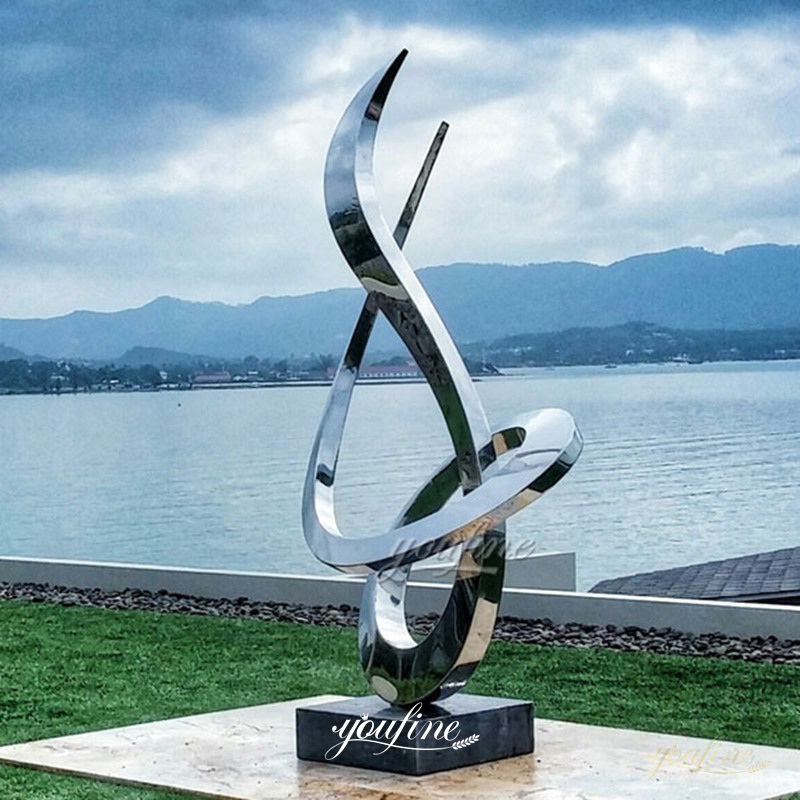
Why Stainless Steel Is the Ideal Material for Sculptures?
Stainless steel offers exceptional corrosion resistance, high strength, and remarkable shaping versatility. It withstands harsh weather, requires minimal maintenance, and delivers a modern aesthetic that suits both indoor and outdoor installations—from geometric abstractions in corporate lobbies to organic forms in public parks.
Common Grades and Thicknesses
The three most common grades used in sculpture fabrication are 201, 304, and 316.
| Grade | Corrosion Resistance | Cost | Best Application |
| 201 | Moderate | Lowest | Indoor or painted budget projects; prone to rust outdoors |
| 304 | High | Medium | Most outdoor sculptures (over 60% market share) |
| 316 | Very High (contains molybdenum) | ~20% higher than 304 | Coastal areas, waterfront installations, high-humidity zones |
For large public sculpture placed near the sea, fountains, or high-humidity environments, we typically recommend 316 stainless steel. The reason is not only its higher corrosion resistance, but also its long-term performance in environments where salt and moisture constantly affect the surface. Many clients initially consider 304 to reduce cost, but after reviewing past coastal projects, we have found that 316 steel significantly reduces maintenance concerns over time. In most cases, the additional cost—around 20% compared to 304—is offset by decades of stable, maintenance-free performance.
For standard outdoor environments, 304 stainless steel remains the most widely used choice. It provides a balanced solution between durability and budget, and works well for landscape sculptures, commercial installations, and public art projects away from coastal corrosion risks.
Regarding thickness, we usually work within a range of 1.5mm to 3.0mm depending on the sculpture size and structural requirements. In practice, 2mm to 3mm sheets are the most commonly used because they offer a good balance between structural strength and forming flexibility. Thicker plates provide higher stability for large-scale sculptures, but they also require more advanced forming and welding skills during fabrication.
Step 1: Design Development and 3D Modeling Process
Every stainless steel sculpture begins with an initial artistic concept, which is gradually transformed into a precise and buildable structure through professional design development.
In this stage, our artists first create hand sketches or reference-based concepts to capture the overall form, proportion, and artistic intention of the sculpture. Once the direction is confirmed, the design is developed into detailed 3D CAD models. This allows both visual refinement and structural evaluation before fabrication begins.
For large-scale or complex sculptures, our design team also performs proportional scaling and technical adjustment to ensure the artwork remains visually balanced when enlarged to its final size. This process, often referred to as lofting, ensures that curves, transitions, and surface details remain accurate during fabrication.
At YouFine, we place strong emphasis on this stage because a well-developed design not only defines the artistic expression of the sculpture, but also determines how smoothly it can be manufactured in later processes such as cutting, welding, and assembly.
Step 2: Cutting and Hand Forging of Stainless Steel Sheets
Once the material is ready, the fabrication begins with cutting the sheets into the required shapes.
Cutting Methods:
- Laser cutting – for precise, intricate designs with clean edges.
- Plasma cutting – for thicker materials and larger pieces.
- Shearing – for straight cuts on thinner sheets.
Workers mark the plates with layout lines based on the design, then cut each piece to exact dimensions.
Shaping and Forging:
At YouFine, all forming work is completed through manual hand forging by skilled craftsmen. The metal is gradually bent, hammered, and adjusted to achieve the required curves and shapes, especially for organic or complex designs.
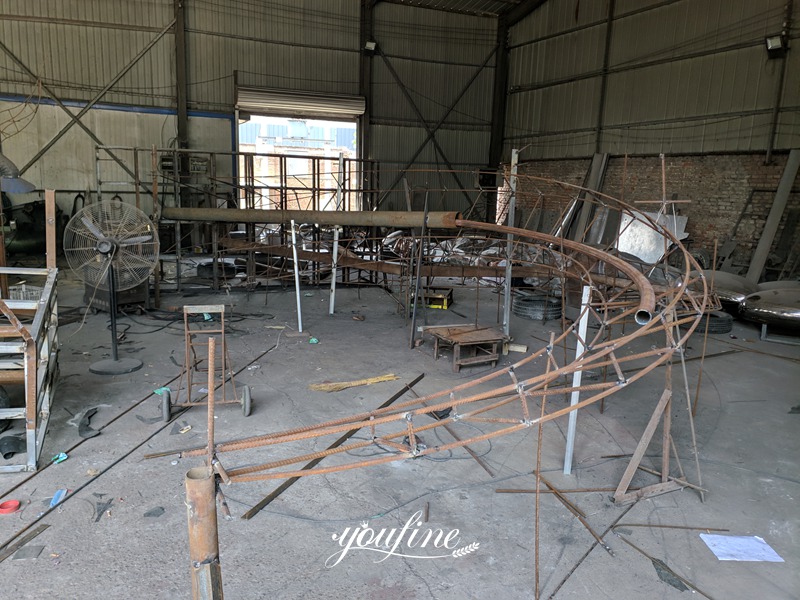
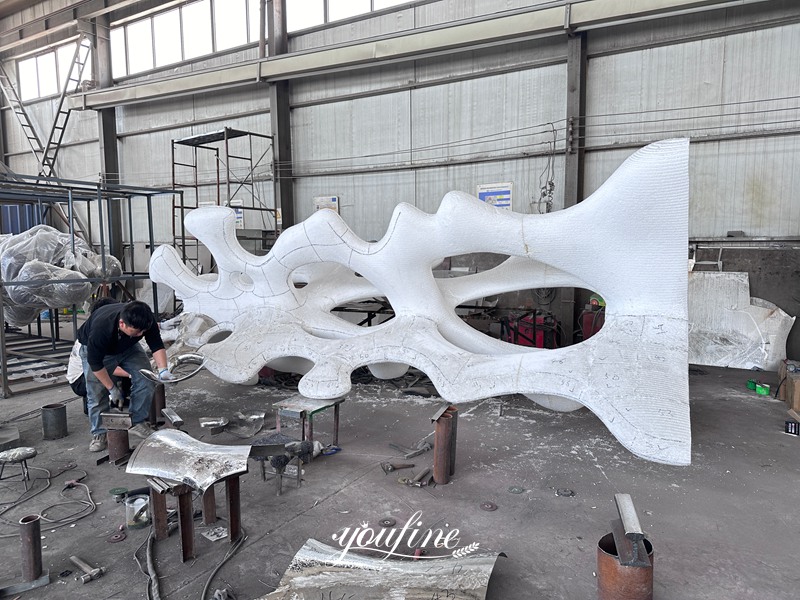
- Simple sculptures (no model): A structural steel skeleton is built and rust-proofed, then stainless steel sheets are welded directly onto it.
- Complex sculptures (model required): A plaster model is first created and dried. The stainless steel pieces are shaped over this model, then transferred to the metal framework.
Step 3: Welding, Structural Assembly, and Hand Grinding Finishing
Welding assembles all the individual pieces into a unified sculpture, while grinding smooths the joints into an invisible seam.
Welding Process:
- Spot welding temporarily holds pieces in place.
- Full welding: TIG welding is applied to create strong and permanent joints.
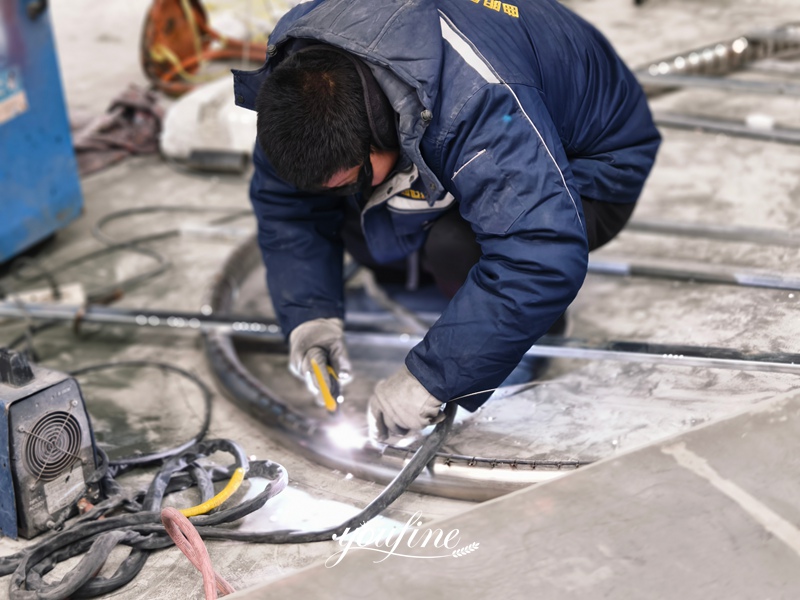
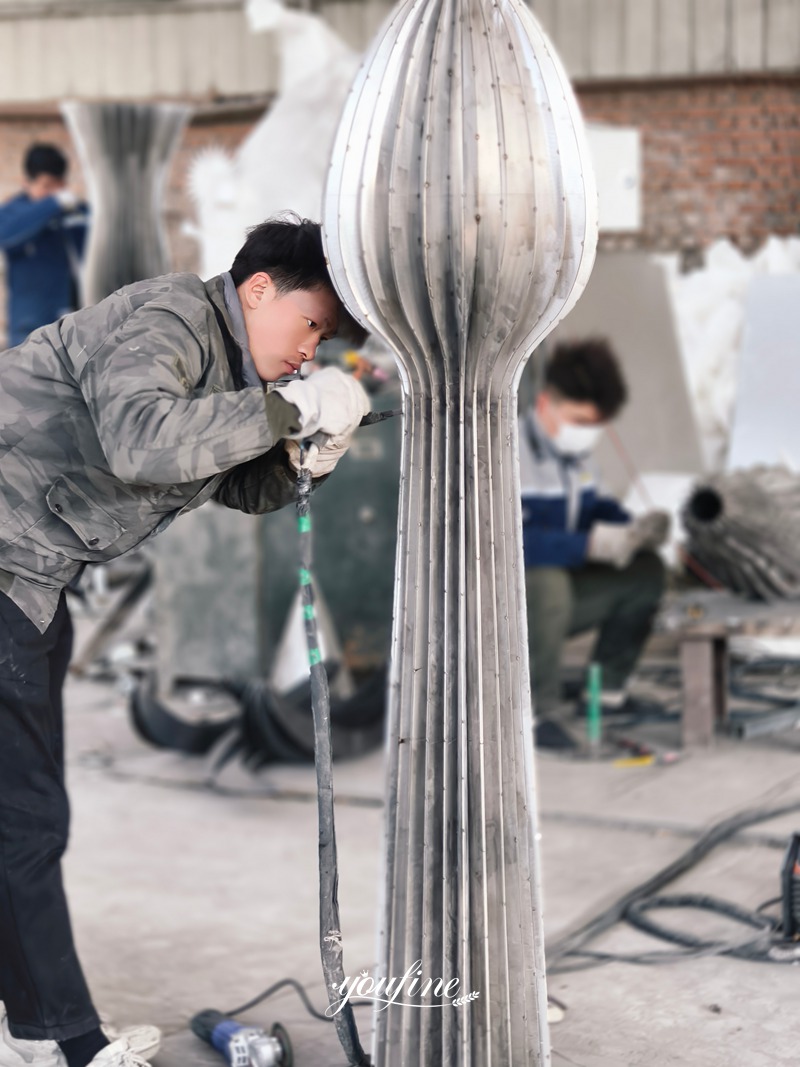
For large sculptures, an internal steel structure made of channel steel, pipes, and angle steel is fabricated first and treated with anti-rust coating, after which the stainless steel skin is welded onto the frame from bottom to top.
Grinding and Smoothing:
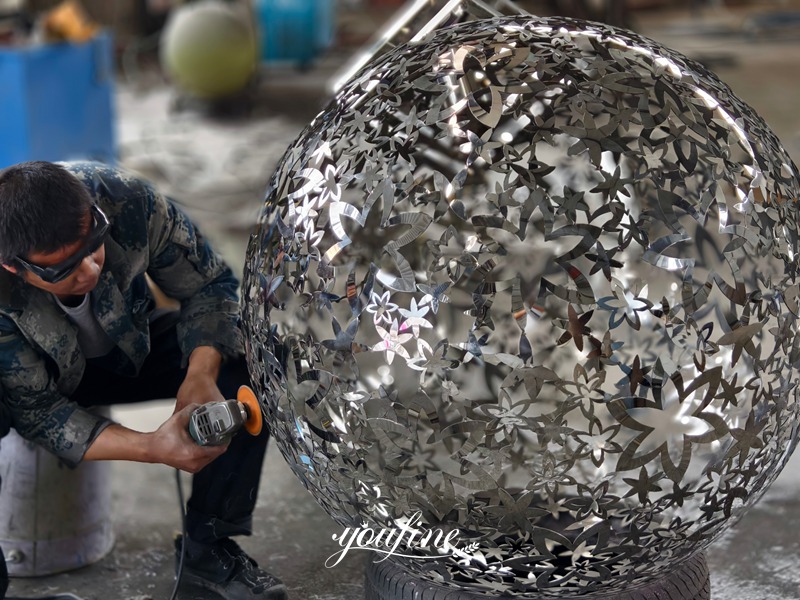
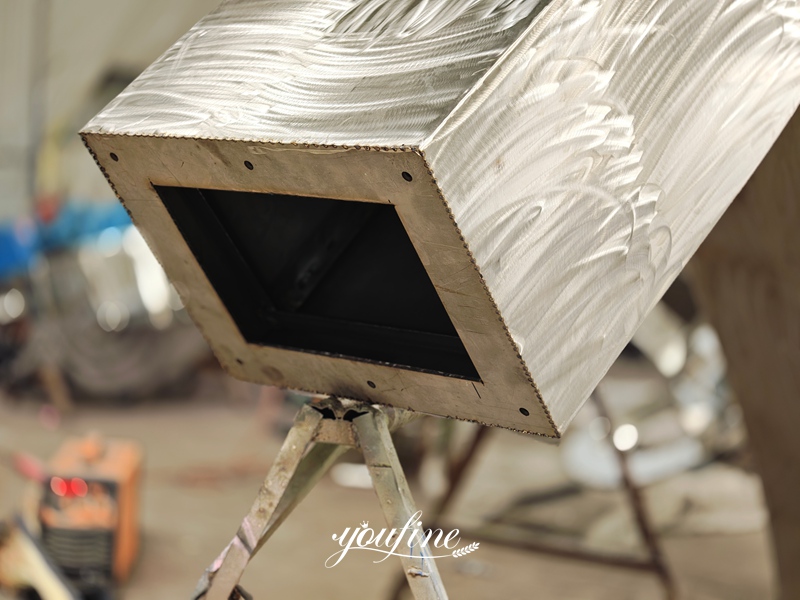
Once welding is completed, all seams are carefully ground and refined by hand. Our craftsmen use different grit levels of grinding wheels.
- Coarse grinding—starting from coarse grinding to remove excess weld material
- Fine grinding—using medium and fine grinding to smooth the surface and eliminate visible transitions
Step 4: Surface Finishing Options and Visual Effects
Surface treatment defines the sculpture’s final look and feel. The choice of finish dramatically affects how it interacts with light and its surroundings.
| Finish | Description | Visual Effect | Best For |
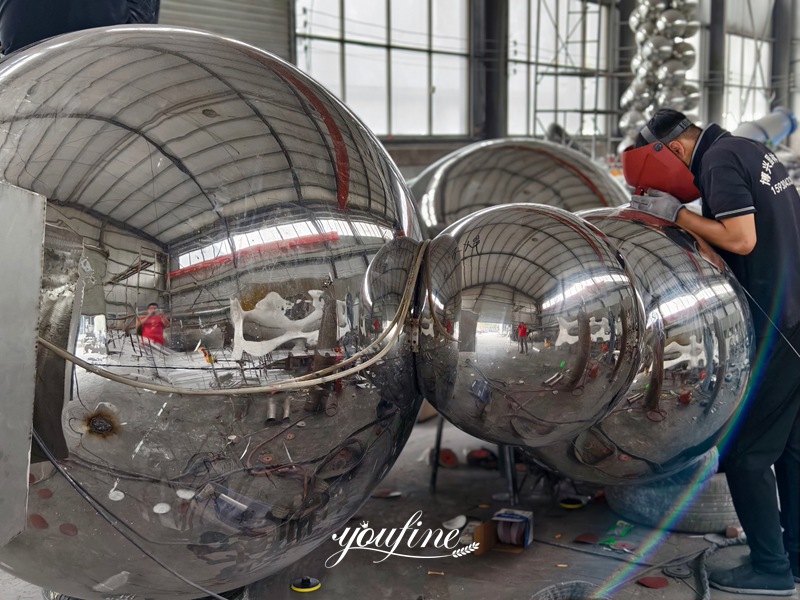
| Mirror Polished | Polished to high reflectivity | Reflects surroundings like a mirror; 95% light reflectivity | High-impact urban installations, luxury settings |
| Brushed / Satin | Fine linear scratches create texture | Subtle, elegant, non-reflective | Corporate lobbies, contemporary designs |
| Painted / Coated | Paint or powder coating | Any color, matte or gloss | Budget projects or when a specific color is required |
At YouFine, we primarily recommend and specialize in mirror-polished finishes, as they best highlight the dynamic reflective effect of stainless steel sculptures in real environments. Based on our previous project experience, mirror polishing is also the most popular choice among clients for landmark installations and high-visibility public artworks, as it creates a strong visual impact under natural light conditions.
Step 5: Quality Inspection and Packaging Process
Before leaving the workshop, every sculpture undergoes rigorous quality checks.
Inspection Checklist:
- Dimensional accuracy – Does it match the approved design?
- Weld quality – Are all seams smooth and structurally sound?
- Surface finish – Is the finish consistent and free of defects?
- Structural integrity – Is the internal skeleton properly secured?
Packaging for Transport:
- Small sculptures are packed in wooden crates.
- Large sculptures are wrapped in soft padding, then secured inside a steel frame to prevent movement during transit, and loaded directly into shipping containers.
Step 6: On-Site Installation and Foundation Construction
Proper installation plays an important role in ensuring the long-term stability of a stainless steel sculpture, especially for large outdoor or public art projects. With accurate engineering drawings and proper preparation, we can complete the installation process safely and efficiently.
For large sculptures, a two-stage concrete foundation is standard:
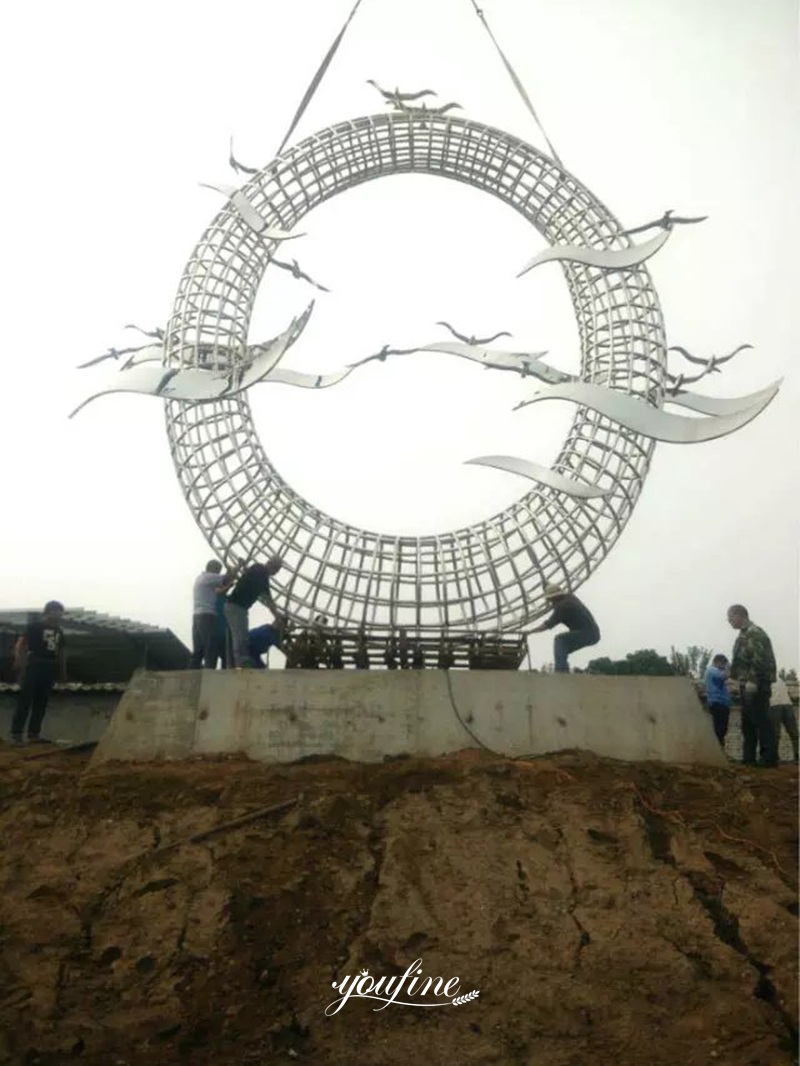
First pouring (before delivery): The client excavates a pit and pours a concrete base with reinforcing steel bars protruding upward. The foundation must reach below the frost line (typically ≥1.5 meters).
Second pouring (after delivery): When the sculpture arrives, its steel base frame is positioned on the prepared foundation and welded to the protruding rebar. A second layer of concrete is poured over the base frame, permanently embedding it. The concrete surface is then finished with tiles or stone for aesthetics.
For multi-piece sculptures, the sections are assembled from bottom to top on-site. Each joint is welded, ground, and polished to create a seamless appearance. Proper installation ensures the sculpture remains stable and safe for decades.
At YouFine, we provide detailed installation drawings for every project. Clients with experienced local installation teams can complete the installation independently. For projects requiring additional support, our engineers and installation technicians can also be dispatched to assist on-site assembly, ensuring the sculpture is installed safely and correctly in its final location.
Why Does Every Step of the Manufacturing Process Matter?
Creating a stainless steel sculpture is far more than cutting and welding metal. Each step—design, material selection, cutting, shaping, welding, grinding, surface finishing, and installation—requires skill, precision, and attention to detail.
- Design and lofting ensure the sculpture matches the artist’s vision.
- Material selection determines longevity and maintenance needs.
- Cutting and shaping give the sculpture its form.
- Welding and grinding create strength and visual seamlessness.
- Surface finishing defines its aesthetic character.
- Installation ensures it stands safely for generations.
When you commission a stainless steel sculpture, you’re investing in a process that combines artistry, engineering, and craftsmanship. Understanding this process helps you appreciate the value of what you’re purchasing—and make informed decisions at every stage.
Looking to commission a stainless steel sculpture for your next project? With over 40 years of experience, YouFine has worked on projects from small garden pieces to large-scale public art. Feel free to reach out—we would love to discuss how we can bring your vision to life.
Tina
Sculpture artist and content contributor at YouFine Sculpture, sharing insights on metal art, craftsmanship, and creative process.
View All PostsHow to clean stainless steel sculpture?
When talking about the stainless steel sculpture cleaning methods, here are more details about first time cleaning, routine...
Read More
How to Choose a Metal Wall Sculpture?
A well-chosen metal wall sculpture can do more than fill an empty wall. It can bring personality to...
Read More
What Is the Famous Sculpture Balloon Dog ?
Balloon Dog is only one part of Koons’ broader Celebration series, which includes other works inspired by festive...
Read More